My printer passed away last night. The print head had a massive heart attack. I performed several emergency medical procedures prescribed by my HP Solutions Center–all to no avail. Funeral services will be announced.
A helpful store clerk at Office Depot informed me that print heads often break within two to three years. “It costs nearly as much to repair them as it does to buy a new printer,” he added, smiling. I did not argue with the man. Some critical part of every printer I have ever owned has broken down within this time-frame, and it never makes economic sense to replace the part.
Yet, I continue to buy HP printers, despite their limited life-span and the outrageous prices of the ink they voraciously consume. HP is a market leader, and I follow the herd because I shudder to think what catastrophes await the buyers of lesser brands.
Most printers displayed on major retail shelves are made in horrid factories by underpaid workers somewhere in China. I tell myself the HP factories are less horrid and produce better products than the others. At least I know what I’m getting when I buy an HP printer: a short but trouble free life span and high quality inks at unconscionable prices.
My new printer cost $329.00 and the new ink cartridges cost $109.99. My old printer expired with about $50 worth of unused ink. Naturally, the old ink cartridges are not transferable. This brings the total cost of my new printer to $$38.99, not including sales tax.
As we all know, it’s not the cost of the printer that hurts. It’s the cost of the inks. I find that my color ink cartridges last about three months each, and the double size black cartridge lasts about six months. I am convinced the life span of HP ink is controlled by a secret technology kept ingeniously under wraps by the manufacturer.
My cartridges need frequent replacement regardless of the steps I take to economize on ink. If I avoid printing in color, my color cartridges still need to be replaced. The only explanation I have for this is that the secret HP technology enables the color cartridges to combine mysteriously to print in black.
My New Printer
If I cut down on using my printer, it makes no difference. In this case, the secret technology causes the ink in the cartridges to evaporate at a predetermined rate, thereby ensuring a three-month replacement cycle.
Adding to my consternation, it took me three hours to set up the new printer. It used to be easy to set up a printer. There was basically one way to install the damned thing, and it was easy to follow the idiot-proof instructions. Now, there are several options at every step of the process requiring an advanced degree in engineering to decipher. On one of the setup screens, none of the options fit my setup criteria. I finally decided to go on to the next step without checking any of the boxes. I expected to see an error message pop up, but lo and behold, nothing happened. I had made the right choice, that is–no choice. I had guessed right, but I ask you, doesn’t that sound a bit counter-intuitive?
At some point, we will no longer need printers, paper, or ink. Documents and images will fly through the air directly into our heads. Until that time comes, however, I could use a little advice on the subject.
Every so often, it’s not such a bad idea to give up.
The word I really want to use is surrender, but I’m not really sure what that word means in the truest sense. I’m going to barge right ahead and use it anyway.
Once every ten years or so, I get to the point where I just want to surrender. I feel like I have done everything that can be done to accomplish my goals, and nothing seems to be happening. The feeling usually lasts for anywhere between three minutes and three days.
The funny thing is I find that I actually get somewhere when I reach this point. In one sense, it’s a scary place, a place of desperation, a feeling of being at the end of my rope. But I’ve found it can be an auspicious place. I wrote this yesterday on the subject (in less than three minutes).
I want to go higher, but don’t know how. It seems like I’ve tried everything, only to fall, crashing back to earth, unkindly.
I think, however, I’ve been this way before. When it seems like I have looked in every crevice and corner, turned over every stone, in search of the faintest glimmer of light—the light is usually not very far away.
There comes a time when Grace is met by human effort. I know that Grace will have to come sooner, rather than later, because I have been relentless in my pursuit of peace, joy, and love. Life becomes much easier when you know what you want.
One of the good things about advancing age is that it makes it easier to focus on priorities. I mean real priorities—the meaningful stuff, because the clock is ticking, louder and louder. There simply isn’t time to screw around with trivialities and false values. I’m tired of the tricks my mind plays on me. I’m tired of chasing my tail. I’m tired of being lost in the fun house of illusion.
I want the real thing—the beauty within my heart—and I know that it can’t be far away. I’ve been everywhere, done everything, made a fool of myself, and accomplished a few things. You can’t elude me much longer, dear Friend.
Photo Credits: “Sunset Over Mexico” by Bettina Schwehn / uniqraphy , Illusion Photo by Mateusz Stachowski
Why is President Obama determined to attack Syria when the rest of the world is reluctant to do so?
It is troubling that our President is hell-bent on making the same mistake that previous administrations have made by involving the United States in situations where we don’t belong. It is ironic that this President promised to do business differently than his predecessors when he first ran for office.
Our country no longer wields the economic might it once did in the 1950’s, 60’s, and 70’s. This unfortunate fact of life gives us less of a margin for error than we have enjoyed in the past. We can’t afford to squander precious resources on a limited strike against Syria. Many lawmakers in the Congress and Senate believe a unilateral missile attack by the U.S. will have little or no effect aside from killing more innocent people.
We have many social issues in America crying out for resources and constructive solutions. The last thing we need is an ill-conceived, destructive attempt to impose our will in Syria.
Referring to Asad’s attack against his own people, Obama recently said, “It makes a mockery of the global prohibition of chemical weapons. It endangers our friends and our partners along Syria’s borders, including Israel, Jordan, Turkey, Lebanon and Iraq. It could lead to escalating use of chemical weapons, or their proliferation to terrorist groups who would do our people harm.”
This paranoia-laden statement echoes similar statements made by past administrations to justify military intervention abroad. As in the past, Obama’s statement conveniently ignores or twists the facts. Asad has his hands full fighting against his own people. The chances of Asad attacking his neighbors are practically nil. As far as our national security is concerned, what do you think a U.S. attack on an Arab country will do to further endear us to terrorist groups? It will only serve to stoke the fires of their hatred towards this country, of course. An attack against Syria will only make the world a more dangerous place for U. S. Citizens.
It is easy to see that there is no real justification for the U.S. to take it upon itself to launch missiles into Syria. I view such an attack as an act of senseless violence. We the people are responsible for peace on earth, not the government. I intend to let my representatives in the Senate and Congress know how I feel. Let your voice be heard.
Guest-blogger Chip Presendofer provides us with a unique perspective on the steps he and a dedicated group of individuals have taken to launch a Peace Education Program in Berks County Jail, Pennsylvania. Volunteers like Chip and his team are introducing The Peace Education Program in prisons, colleges, universities, civic groups, hospices, and other institutions around the world. Peace Education (PEP) and Food for People (FFP) are two humanitarian aid programs developed by the Prem Rawat Foundation (TPRF).
PEP Team (Not All Members Pictured)
In January of 2013, I reviewed the latest Peace Education Program curriculum with three other people at a friend’s house. Ever since I first heard about the Peace Education Program, I’ve been motivated to contact local prisons, but all my early attempts met with rejection. The curriculum renewed my enthusiasm, and seeing a video about the Peace Education Program in prisons titled “Peace on the Inside” last summer made me feel we had a real story to tell. I think the idea of bringing a message of hope to people who have made some poor choices in their lives is worth the effort.
Feedback from Dominquez State Jail in San Antonio confirms my feeling. We began by hatching an action plan. Two team members wrote an introductory letter and compiled a list of potential recipients who we felt would be able to help us get the Peace Education Program information in the right hands. We sent about ten letters and got a nibble in neighboring Berks County.
On Thursday, February 21st, we met with an official who told us to follow-up with a specific commissioner on the prison board. We persistently followed up with the commissioner, and on February 28th, 2013 we received a letter from the warden expressing interest in implementing the Peace Education Program in Berks County Jail.
Now what? We had to wait until prison management allocated staffing and space resources at the jail. In the meantime, there was paper work to complete for background checks and volunteer training. In April, the prison scheduled training for July 17th, so we were in a holding pattern.
At this point, it seemed like a good idea to bring together everyone who had an interest in PEP under the premise of reviewing the curriculum materials. The thought was that a team of volunteers would identify themselves over successive meetings, and that’s exactly what happened. Every Sunday for about six weeks we met, reviewed the PEP curriculum, and discussed all the information we could glean from everyone involved with PEP. A number of people in the United States, South Africa, and Canada were extremely helpful and forthcoming with information and advice. We were hearing about what volunteers had done, what not to do, what they had learned, and how rewarding it was to actually bring a message of peace and hope into a prison environment.
Five people attended the Volunteer Training at the jail in July. It became very real for us at that meeting. The list of things that could go wrong and the picture painted of the inmates was an eye-opener. As it turned out, the staff instructors were making us aware of what could happen in a worst-case scenario, but when we asked both of them if they would allow their sisters to volunteer, without hesitation they both said yes. This made us feel a little more comfortable, but there were still a lot of unknowns. We discussed our fears and concerns in our meeting and we all decided the risk was worth the effort. It was a real moment-of-truth that we shared and the experience solidified our resolve to keep moving forward.
Peace Education Classroom
On August 2nd, two PEP team members met with the volunteer coördinator at the jail to look at the classroom and confirm a start date on August 9th. The classroom we chose was large enough for twenty students. On Friday, August 9th, we held our first class. Seventeen inmates attended. After all the students arrived and took their seats, I briefly told them we were going to play a video to give them a sense of what was going to take place and then I would take attendance. All eyes seemed fixed on the screen at the beginning of the class. It was easy for the students to relate to the prison scenes and the inmate interviews kept their attention.
I took attendance by calling out everyone’s name and tried to make sure I pronounced the names correctly. Prior to putting in the first video, I thanked the students for coming and said that the information they were about to see was directed to them as human beings. I asked them to try to listen without comparing it to anything they had heard before. Then I pushed the button on the remote and the class was underway. The class proceeded smoothly, although it seemed the longer videos challenged some students’ attention spans. Experienced PEP volunteers had advised me that it would take a few classes for the energy in the room to jell and for people to feel comfortable enough to ask questions and expose their thoughts.
The inmates came from different cell blocks. Some knew each other (fist bumps) while others were not acquainted. In general, the inmates had no trouble finding seats and being in relatively close quarters. They were orderly, quiet, attentive and helpful. Perhaps in our next class, I’ll invite them to share a little of what they heard and hopefully get them a little more involved.
Before we knew it, the class was over. After replacing the tables and chairs to their original positions, all the inmates wound up standing in a circle around the perimeter of the room. The atmosphere was instantly more relaxed and one man asked whether a person without a conscience could find the peace within. I said those are two different things. Consciousness is being aware of your existence and conscience helps us distinguish between right and wrong. I said I didn’t think a person without a conscience would seek the peace within, but I didn’t really know. He thanked me for being honest with him, and then he said he was just trying to sound smart and not to pay him any mind. I said I was just trying to sound smart also, and that got a laugh from a few people. It was the first time during the class that it felt like we might have connected a little more on the personal level.
Inmate Housing Unit
I received another important piece of advice from my fellow volunteers: It’s important to connect personally with inmates without getting too involved. That advice makes a lot of sense to me. The students don’t have to like us individually, but they should know we relate to them as human beings, not as prisoners. This is a fine line, but one that holds significant promise for us as facilitators. If we respect the inmates, there’s a good chance they’ll respect the volunteer team and feel comfortable enough to reveal their thoughts in class. I don’t feel it’s my place to draw the students out, but I do feel like I need to create an environment that will allow them to open up if they wish.
The ability to walk out of the prison made me realize how fortunate I am and what a privilege it is to be able to make my own decisions about my day. Driving home, someone asked me how I felt, and I answered, “Relieved and curious.” Relieved we had broken the ice and now had an idea what we needed to do for next week and curious to see who will return.
With only one class behind us, we have many, many more to go. This is a marathon, not a sprint, and one lit candle can light hundreds of others. We’re on our way, and for that I’m thankful. Looking back, it took a lot of effort to get the program started, but the journey has just begun and the bulk of the effort is still in front of us.
All this talk about overpopulation is finally beginning to hit home. Lately, it seems like almost everywhere I go, hordes of people come crawling out of the woodwork.
It’s really becoming annoying. Take, for example, a trip to the mall. You have to use a slide rule to calculate the ideal time to go, to avoid peak hour pedestrian traffic trampling you underfoot.
At the rate the world population is growing, many of us will have to consider living on another planet in some distant galaxy. It won’t be long before scientists discover a suitable planet to colonize and they build a faster-than-light-speed spacecraft to take us there. I’m going to make sure my retirement account is healthy enough to buy a one-way ticket for me and my family to make the journey.
Starting over, however, is not going to be easy. There won’t be any NFL or NBA games to watch, golf to play, books to read, or computer games to play—save the ones we take with us. My wife and daughter will miss Lifetime, Housewives, nail salons, and shopping malls, to mention only a few life staples, before civilization reasserts itself.
How did we get ourselves into this situation? According to an actuarial study commissioned by the US Social Security Service, life expectancy has increased by 28 years for men and 26 years for women from 1900 to 2001. According to the same study, this is due to several factors:
• Access to primary medical care for the general population
• Improved healthcare provided to mothers and babies
I’d like to add one more item to this list: Thanks to medical science, people are living longer. In my humble opinion, some people are living longer than they should. Please allow me to explain.
As I write this, I’m sitting in a cancer center waiting for a vitamin B-12 shot and thanking God I don’t have cancer. I see people shuffle in, many in their eighties and nineties, supported by walkers and canes, wearing bandages, heads bent, half asleep. You have to feel sorry for these people while praying you don’t wind up like them.
Certainly, cancer has many causes, but one of them is simply the aging process. We reach a point where our immune system grows too feeble to protect us. At this point, the party is over. We become like AIDS patients before the curative cocktail, with nothing to look forward to but one disease after another.
Yet people hang on, thanks to the wonders of medical science, hoping life will one day be worth living again. Maybe that day will come when full-body transplants become available. If this doesn’t happen in the next ten or twenty years, I hope I will have the wisdom to know when it’s time to gracefully exit stage right (or left.) To put it another way, to have the courtesy to make room for someone else and stop contributing to escalating healthcare costs.
In the meantime, I’ll go on meditating, exercising and pursuing the interests that make me feel happy-from-the-heart. And for the sake of EVERYONE’S quality of life, can we PLEASE be a little more conscious by making fewer babies?
Nobody likes it. I am no exception. We’re talking about jury duty, of course. I kept trying to forget the impending date, but something kept reminding me, like, the Jury Summons itself sitting in a corner of the bedroom on my desk. Despite the negative anticipation and a six a.m. alarm, I wound up having a pretty good time on my day in court—believe it or not.
For starters, the clerk called out my number and name among the first panel of prospective jurors summoned that morning. I went directly upstairs to await the process of Jury selection instead of sitting in an over-crowded room of eight hundred people coughing, burping, farting, and talking on their cell phones.
Being selected randomly by the computer for the first panel of jurors equates to winning the lottery…well, maybe the scratch off lottery. I sat in a waiting room outside the courtroom on the fifth floor with seventeen other fortunate souls awaiting Voir Dire (to speak the truth) also known as jury selection. The bailiff ushered us into the courtroom where six attorneys (three for each side) and the judge awaited us. Everyone except the judge stood during our entrance out of respect for the judicial system and our suffering…whoops, I mean our service.
I feel compelled to interject a few words about the judge here. She belied all of my preconceived notions about judges, the product mostly of television programs. She showed uncommon courtesy, sympathy and compassion for the jurors, and a kindness as well as fairness towards the attorneys.
The judge read a brief overview of the case to us. It involved a former police officer who was suing the girl who stabbed him while on duty and Wal-mart where the crime occurred.
Now the process of Voir Dire began in earnest with the lead attorney for the plaintiff asking us a series of questions. Here are some of the highlights. When asked if anyone on the panel had a problem with personal injury lawsuits, two gentlemen and one woman offered that they believed more than fifty percent of PI lawsuits were frivolous. Another woman stated that she, as a Christian person, had a problem with all lawsuits, professing that people should not sue one another.
When asked about our opinions about lawyers in general, one gentleman said, “I hate lawyers. My ex-wife and her scheming attorney sentenced me to a lifetime of alimony payments.”
It seems to me the only explanation that people make statements and express views such as these is for the express purpose of being relieved of the burden of jury duty.
After a lunch break, the lead defense attorney approached us for questioning. He began by asking, “Does anyone on the panel bake.” Three women raised their hands. The Plaintiff’s attorney immediately objected. “We don’t have any cakes or baking in this case.”
The Judge allowed the defense some leeway when the defense attorney promised to, “tie in” the question. He made the point that baked goods must have a specific number of ingredients included for a successful result. Failure to include one or more ingredients will doom the baking project. In a similar fashion, the plaintiff’s attorneys were duty-bound to prove all the elements required by law for the jury to award damages.
It dawned upon me that attorneys begin indoctrinating the jury even before the formal proceedings begin. You learn something new every day.
The defense attorney then asked us if anyone had a bad customer experience at Wal-mart. One gentleman raised his hand. Under repeated questioning, he admitted a manager resolved the matter to his satisfaction.
Then the attorney dropped, what turned out for me, the hydrogen bomb. He asked if anyone on the panel “had a problem with Wal-mart in general.” In that moment, I realized I did—a big problem.
I flashed back six months to a PBS Frontline documentary titled, “Is Wal-mart Good for America.” I found it enlightening and a bit shocking.
I proceeded to tell the attorney that I did have a problem with Wal-mart. He said he would question me in private about it. Obviously, he didn’t want my opinion to contaminate the other panelists.
After the defense attorney finished his questions, I expressed my views with the other jury members outside the room. I said I had learned from a PBS documentary that Wal-mart is a major contributing factor to the erosion of the manufacturing base in this country and our widening negative balance of trade, with more products imported than exported.
Wal-mart buys most of its products from China. Sam Walton, the founder of the company, had a firm policy of buying American. Unfortunately, Sam Walton, along with the rest of the world, has passed on.
I also learned that Wal-mart underpays its employees, despite making thirteen billion in profits in 2012. In addition, the company indirectly supports the policy of many foreign manufacturers paying their employees what amounts to slave wages to produce at prices low enough to satisfy Wal-mart.
Wal-mart also practices deceptive advertising. They promote low prices on loss leader items while many other items in the store match the prices of other major competitors. Wal-mart makes more profit on these items than their competitors due to their massive buying power, but the savings are not passed on to the consumer.
I concluded my remarks by saying in my opinion Wal-mart does not serve the public interest. The company does not contribute one iota to the standard of living of anyone in this country. Instead, Wal-mart detracts from our quality of life by making it harder to find a good-paying job or to own and operate an independent business, small or large. I embellished these remarks with one final stroke of the sword: “Wal-mart is a cancer growing steadily in developed and developing countries worldwide.”
The defense attorney just stood there behind his lectern in disbelief.
In trying to discern my motives for this outburst, I have yet to come up with a solid answer. Should I commend myself for telling the truth, or did I simply find a creative way to weasel out of jury duty? I honestly don’t know.
Last year, TPRF partnered with The Adventure Project to help transform fifty farmers into profitable entrepreneurs in Kenya. We are proud to report that those farmers have moved from poverty to the middle class, and are sending 75 of their children to school for the first time from the money they earn selling produce. Here is a story written by guest blogger Becky Straw, Co-Founder of The Adventure Project, demonstrating the impact this gift is making to feed the hungry in Kenya.
I wish I could take you here. I wish I could take you by the hand and sit you next to me on Hannah’s couch to experience her story in person.
I sat and appreciated the modest house, just one small living room, flanked by two simple quarters on either side. A single light bulb hung from the tin roof, and dozens of baby chicks chirped relentlessly outside. Inside, I admired the walls, every inch covered with images. Soccer posters, old calendars, and embroidered wall hangings. Looking closer I saw that they were bible verses, stitched in between happy flowers: “To whom much is given, much is expected.”
Upon our arrival, Hannah shrieked playfully, like so many women would, “You have arrived early, don’t film me yet – I haven’t done my hair!” We laughed and nodded in understanding as she ducked into the next room.
While I waited as she primped, I asked her son, Steve, how he’s doing in school. He modestly mumbled, “good,” like a typical teenage boy, even walking with the gait of a sudden growth spurt. I pushed harder until he finally puts aside his 7th grade indifference and confessed to us his dream. “When I grow up I want to work in hospitality management.”
Hannah With Son Steve
“Why?” we ask.
His neighbor is a hotel manager, and he has a good house, he admitted. There’s also a chance that the President might come into his hotel, and that would be very exciting. It’s a modest dream, but it’s achievable. It’s possible because he has excellent grades and because of his family. Because of his mother.
Outside, Hannah hands me a large package, wrapped in yellowed plastic tarp and tied up with string, like a present. I balance it awkwardly. It takes me a minute to realize, “Oh, this is your irrigation pump.”
Kuyu, the marketing manager for Kickstart, looks at me and smiles, speaking softly, “It’s funny that she wraps it like this. It’s chip-resistant paint. It’s not going to rust or be damaged.” Hannah has had her pump for two years. It still looks brand new.
We tread carefully down a slope to her small garden, walking through trees until we reach a clearing where the sky opens up before us. Fruits and vegetables of every variety lay in neat little rows. Huge fuchsia flowers bloom wildly along her fence. It’s an unexpected Eden.
Carefully, she unwraps her pump and goes to work. Hannah’s farming business has tripled since she purchased her irrigation pump, a fact she is keenly aware of.
Her story is not unique. The benefits of one pump are astronomical. A pump can increase harvests by 3-4 times per year and can irrigate up to 2 acres of land per day. One pump has the ability to move a farmer and their family from poverty into the middle class in just one harvest.
The irony of Africa is that 75% of all subsistence farmers’ children go hungry because they cannot grow enough to even feed their own families. With an irrigation pump, farmers suddenly have so much food that they can sell their surplus in local markets. They earn enough to send an average of 1.5 of their children to school for the first time.
As hard as I try, I can’t think of any single item in America to compare the pump to. What’s the one physical item we have in the U.S. that can transform a poor family struggling to feed themselves into nearly instant middle-class entrepreneurs?
Hannah and Steve Gardening
After Hannah finished watering her garden, she grabbed her old bucket, filled it with water from her small well, and did something I didn’t expect. She began painstakingly washing every inch of her pump free of mud and dirt. Thoughtfully. Methodically. As if she was caring for a precious child.
After twenty minutes she carefully took the pump, laid it on the plastic, tied it up with string, and rolled the hose into a neat coil. I asked if she followed this routine every day.
“No,” Hannah replied. “Plants only need to be watered every other day.” In her own way, she answered my question. I took my notebook out of my backpack and wrote one word in the margin. Value.
Hannah and her husband bought this pump themselves. The Adventure Project is helping to subsidize the costs of the Kickstart program, so that the pump can be sold at an affordable price. No determined farmer is too destitute to pay, and Kickstart has even developed an extended payment program for those truly in need.
With the income generated from selling her crops, Hannah has invested in chickens and now sells eggs along with her produce. She can also afford her son’s school fees, and he will never miss school again because they can’t afford to buy him shoes and socks.
No longer toiling all day under the hot sun, carrying a bucket, plopping water and drenching seedlings, Hannah now has time for her favorite activity, she tells us joyfully – teaching Sunday School at her church.
I cannot think of one investment more precious. More valuable.
This is the Kenya I know and love. The story I want you to be part of. There is no longing. No begging. No swollen bellies or hungry eyes. If there are tears, they are mine. And maybe yours. Welling with happiness. For me, I know I’ve found my calling. The opportunity to play a small role in giving something more valuable than gold; a job.
Friends, we have set an ambitious goal: we want to help 323 other families in Kenya this year. Every $400 will get one pump to a farmer in need. If successful, our funds will help 323 farmers grow enough crops to become profitable – feeding 25,000 neighbors and sending 500 of their kids to school for the very first time. Imagine giving someone like Hannah the opportunity of a lifetime.
“The Adventure Project is incredibly honored and grateful for all TPRF has done to support food, water and peace around the globe. Your support for our Hunger Campaign has directly benefited thousands of people, and your $10,000 gift created jobs for 25 farmers last year. We cannot thank you enough for all that you done and continue to do to make the world a better place. Thank you.” – Becky Straw, Co-Founder of The Adventure Project.
I like movies with heart. “Duets” is a movie with a big heart that nobody went to see. Well, almost nobody. Despite an intelligent, one-of-a-kind script and a star-studded cast, “Duets” tallied a mere 4.73 million dollars in domestic box office sales.* In terms of Hollywood studio economics this paltry sum is tantamount to a financial implosion.
“Duets” is (mostly) a feel-good road movie about people following their hearts and discovering who they are. I don’t see any harm in a story like that, particularly if you can add a few new twists and keep folks smiling. I thought “Duets” did both, but a lot of people disagreed.
I can find only two explanations why “Duets,” a movie I liked, was so universally overlooked by the movie-going public. Explanation 1: I have very bad taste. Explanation 2: An overwhelming number of negative reviews by movie critics cut off the hand that feeds the box office.
According to Metacritic® (www.metacritic.com) a sample of 29 professional movie critics gave “Duets” an average rating of 40 % out of 100. In contrast, a sample of twelve “Users” (people) gave the movie a rating of 8.8 points out of 10. (I realize this is a small sampling of “Users,” but let’s not forget that not many people saw this movie.)
According to this compact study then, “Duets” is a predominantly people friendly movie with an allergy to movie critics.
Here are a few typical movie critic reviews:
“Miserable as it crawls for two eternal hours towards being “life affirming.” Wesley Morris, San Francisco Examiner
“Simply creaks with contrivance—particularly in its overwrought finale.” Curtis Morgan, Miami Herald
“A leaden piece of whimsy that looks for profound life lessons among a group of karaoke bar aficionados.” Steve Daly, Entertainment Weekly
To be fair, some critics praised “Duets, as evidenced by these reviews:
“Her name was Lola. She was a show girl…dah de dah de dah. This movie was fun interesting and catchy. What is better?” James R.
“This movie is engaging, the story unfolds around the music, and Paul Giamatti is great. Apart some predictable things typical nowadays in American movies (family values, etc.), this movie is fun.” Pablo E.
“I loved it. Movie critics suck.” Stephanie R.
“The karaoke scenes were great…the film got me.” John O.
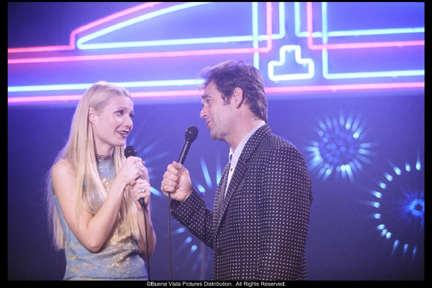
“Bette Davis Eyes…I like this song! Especially when Gwyneth Paltrow sang it.” Jiae K. (I agree with you, Jiae. Paltrow sings the song like a sultry angel in her own voice–no dubbing.)
It’s interesting to note the difference between the critical reviews and the “User” reviews. Critics, for the most part, write about the movie from a purely intellectual and artistic point of view. Believe it or not, I feel strongly this point of view does the movie-going public a disservice. For a more detailed explanation of what I mean by this, please read my earlier post, “Do Movie Critics Have a Heart?”
The people who commented on “Duets” experienced the movie in a completely different way than the critics. They connected with the movie emotionally. They had a good time. People primarily go to the movies to be entertained. I believe this is a fact most movie critics tend to forget.
Here is my own somewhat extended review of the movie.
The script weaves the stories of three sets of people into a road movie unified by the common thread of karaoke. I give the screenwriter, John Byrum, credit for coming up with this unique concept. Before watching the movie, I never knew karaoke bars existed, and people competed in karaoke competitions for cash prizes. I discovered an entire karaoke subculture and its attendant technology. One of the things a good movie will do is open a door to a world you’ve never experienced before. For me, Duets succeeded admirably in this regard.
Good music of any kind never fails to stir the human soul. This comes through in the “User review” excerpts. I found the music and the surprising singing talent of the “A” list actors showcased in “Duets” both refreshing and moving. I am astonished that movie critics, in large part, failed to respond to the musical dimension of “Duets.”
“Hard to take stone-cold sober,” writes critic Jack Matthews of the New York Daily Times.
Instead of asking, “Do movie critics have are heart,” I wonder if it might be more appropriate to ask, “Do movie critics have a heart beat?”
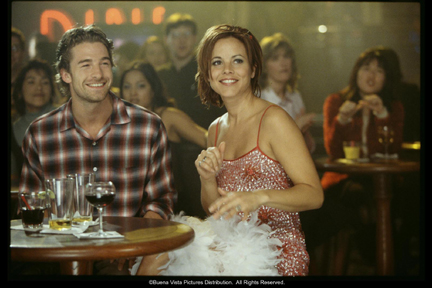
What about the acting? Well, Huey Lewis is definitely a better singer than actor. But I thought he basically got the job done in his role as a karaoke hustler and recalcitrant father. I have some questions about the choices Gwyneth Paltrow made in playing her role as Lewis’ long-lost daughter. I think she was going for innocent, but I didn’t feel it worked. I’d say this was the one major flaw in the film. I thought the other stars, Giamatti, Braugher, andMaria Bello all brought “A list” luster and ingenuity to their roles.
I found the three stories in the movie appealing, and yes, even insightful, some more than others. I enjoy movies that have the unmitigated gall (according to critics) to explore questions like “What the hell am I doing here?” or “What does it take to be a good person?”
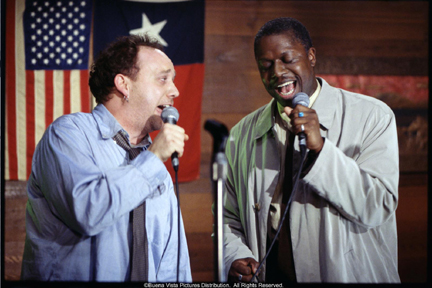
I believe the emotional center of the movie revolves around the disillusioned-with-the American-Dream character of Paul Giamatti playing opposite Andre Braugher, an ex-con. Braugher (Life on the Street) brings his customary moral compass and dignity to the role, plus a singing voice you would not believe he commands if you had not heard it yourself. This can also be said for Gwyneth Paltrow, and to a slightly lesser degree, Paul Giamatti and Maria Bello.
I connected with “Duets” emotionally. Like John O said, “…this movie got me.”
I’ll close by saying it’s very hard to make a compelling, engaging movie that switches back and forth between three different stories.Yet here I am, twelve years later, still thinking about “Duets.” Am I smart or senile to like this movie? Why did it fail at the box office?” Did “Duets” make a comeback in movie rental receipts?
If you have the answers to any of these questions, I’d love to hear from you.
*September 17th to October 29, 2000. Source: Wolfram Alpha Computational Knowledge engine (www.wolframalpha.com)
At the risk of stating the obvious, I’m fed up with movie critics. Critics are supposed to help me find good movies, and they tend to fail miserably at this.
My purpose here is not to be unkind to movie critics. Instead, I’m trying to understand by thinking out loud on paper why movie critics are so unreliable.
Most movie scripts share a common shape. By this I mean the stories are grouped into three acts designed to build dramatic tension, climax, and ultimately resolve the conflict. A number of precise rules for screenwriting success are drilled into the heads of screenwriting students. I have experienced this first-hand as a screenwriting student at UCLA. There are pros and cons to the three-act formula. The good news is that the structure works fairly well. The bad news is that it can impede creativity. Most writers and film makers need a structure or a shared convention to shape their work, no matter how badly they resent it. Genius writers and filmmakers break the rules at will and succeed handsomely. You just have to know where you fit in.
The point I’m trying to make is that there is a basic flow to most movie stories. I don’t think most movie-goers mind the similarity. Critics do. They complain bitterly about it. Unfortunately, not too many people can come up with a movie like Quentin Tarantino’s “Pulp Fiction” every time they pull the trigger.
Critics know this. They aren’t dumb, after all. They are just bored with watching so many stories that unfold in a similar manner. They also get tired of the same themes, over and over again. And the movie they are reviewing often reminds them of one of the many others they’ve seen. They conveniently forget there is nothing new under the sun and filmmakers tend to influence one another. So the pro critic is prone to bouts of grumpiness, a jaded outlook, and unreasonableness.
My intention is not to make excuses for bad movies. We all know there are too many sub-par films hitting the streets every day. I do need to point out, however, that it’s hard to make a decent movie. Many elements have to come together gracefully and, in a way, miraculously.
A good film begins with a good script. After the filmmaker pens or acquires a good script, no easy feat in itself, he or she must assemble a cast of competent actors. In Hollywood, they have to be “A” list actors to get financing. Trying to get a few people from a small pool of famous actors interested in your script isn’t the easiest thing to do in the world.
Add cinematography, sound, makeup, costumes, editing, scenery and other artistic functions requiring a high degree of talent and expertise, and you have an accident waiting to happen unless everyone involved knows what they are doing. Add another intangible element like the chemistry that develops or fails to develop between cast members and crew, and you can see why filmmaking is a risky business.
Obviously, a great deal of blood sweat and tears, not to mention money, goes into making a “major motion picture.” There is no doubt that a lot of movies fall far short of the artistic vision that breathed life into them. But there are a lot of movies that deserve more credit than critics are willing to give them.
I understand that a critic’s job is to criticize. Go ahead and nitpick about whatever aspects of a movie that may not work. But please, I beg, pay a little more attention to the overall effect the movie evokes. That’s what People care about.
In my next post, I’m going to talk about Duets, another movie I felt received short shrift from professional movie critics.
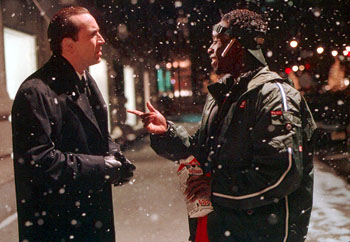
Nicolas Cage and Don Cheadle in a scene from “The Family Man” Copyright 2000 Universal Studios
If there is a hall of fame for under-appreciated or misunderstood movies, then “The Family Man” belongs in it.
For the record, I have studied screenwriting at UCLA, have written three screenplays, and watch at least two to three movies a week. I mention this only to point out that my opinion is not entirely uninformed (off the wall—maybe—uninformed—no.)
Despite this informed opinion, “The Family Man,” starring Nicolas Cage and Tea Leoni, met with lukewarm reviews by critics and movie fans when it came out in 2000.
The story opens with a day in the life of Jack Campbell, a thirty-something, wealthy investment banker who captains a boutique investment firm on Wall Street. Jack is intelligent, ambition consumed, bold, self-centered, and charming. Even though his life revolves around the pursuit of money and the pleasures of the flesh, he is hard not to like. His appreciation of classical music and opera displayed in the opening scenes hints at the presence of a soul.
When this movie was made, Nick Cage was still at the height of his acting career. I believe Jack Campbell is one of his more memorable roles. All of the characters in the movie, for that matter, are finely drawn and acted.
After becoming acquainted with Jack Campbell and the world he inhabits, the screenwriters (David Diamond and David Weissman) waste no time in spinning the tale. Jack drops into a fast-food mart after work on Christmas Eve to buy eggnog and stumbles into an armed altercation between a disgruntled customer and the store owner. Jack intervenes to prevent a violent incident by offering to buy a lottery ticket the owner claims is a fake.
In the aftermath, outside of the store, Jack speaks with the disgruntled customer, played by Don Cheadle. Cheadle happens to be an angel on a routine mission designed to teach the Chinese convenience store owner a lesson in racial tolerance. The owner doesn’t learn his lesson, which puts the angel in a foul mood. Unwittingly, Jack contributes to the angel’s frustration with the human condition by making a condescending remark indicative of his superior attitude. The angel decides to teach Jack a lesson by sending him into an alternate reality that “might have been” if he had not deserted his college sweetheart to launch his career as an intern at an investment firm in England. The angel gives Jack a chance to get a “glimpse” into a life based on a completely different set of values than the values he now holds dear.
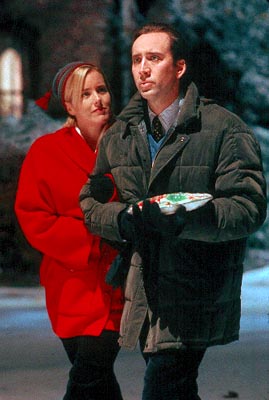
Tea Leoni and Nicolas Cage Copyright 2000 Universal Studios
A big dog slurping Jack’s face wakes him up in bed next to the woman he left cold “in real life.” He is shocked and horrified when two young children pile on top him. The kids are under the ridiculous impression that Jack, a lone wolf of Wall Street, is their father.
In “The Family Man” Jack’s disdain for middle class values slowly turns into respect, caring, and finally a deep concern for the people who surround him. This synopsis really doesn’t do the movie justice. I found almost every scene in the movie poignant. Many of the scenes are multi-layered with subtle observations about human nature and social issues. The dialogue and situations are clever and insightful without a hint of cliché.
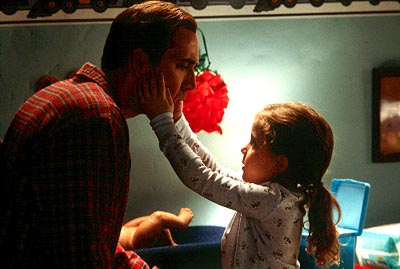
The movie moved me to the point of tears in three or four scenes. One example involves Jack’s relationship with the little girl who would have been his daughter in his alternate life. The little girl, Annie, senses Jack is not her “real father.” She concludes Jack is an alien and asks him where the mother ship is so she can get her father back.
In a scene towards the end of the movie, Jack and Annie frolic in the snow on Christmas morning. By now, Jack has formed a bond with the child. Jack falls down and Annie crawls onto his chest. With a precious smile, she says, “I knew you’d come back.”
I lost it right there.
Many critics commented that the movie over-sentimentalized middle class life. I disagree. I feel the movie artfully portrayed the bumps and warts of middle-class existence, as well as the pitfalls and emptiness of Jack’s investment-banker life. Neither of the two Jacks had it all. Regardless, I found the lifestyle issue secondary. The element of the movie that spoke to me the loudest was Jack’s transformation.
Makenzie Vega and Nicolas Cage Copyright 2000 Universal Studios
“The Family Man” isn’t the only movie I liked that critics and movie fans, in disturbing numbers, deemed “overly sentimental.” Either my sensibilities are inverted, or I’m incredibly sane. Whatever the case, I’m sticking to my guns. I just want to point out that as the world grows more cynical and hardened, it appears good movies are becoming an endangered species. I believe there is a direct connection here. Think about it.
Fictional movies reflect our world while creating their own realities. They are, by definition, abstractions. However, good movies have the power to inspire us to rise above fears and other roadblocks in the way of a better life and a better world. They teach us, often, to listen to our hearts. This isn’t always easy. One has to develop a relationship with one’s heart to hear it.
Feeling, I find, is a first step in cultivating a relationship with the heart. I believe that cultivating a relationship with the heart is essential to leading a full life. There is no one way to do it, but I feel strongly that the human heart needs to be cultivated, just like abs, biceps, WordPress blogs, and Facebook pages.
I liked the “The Family Man” because it made me feel. I practice meditation every day to cultivate a relationship with my heart. You might say the practice helps to “tenderize” my heart center. This movie reminded me that I have one.