Categories
acoustic guitar Arts & Entertainment folk music Music

If You Could Read My Mind

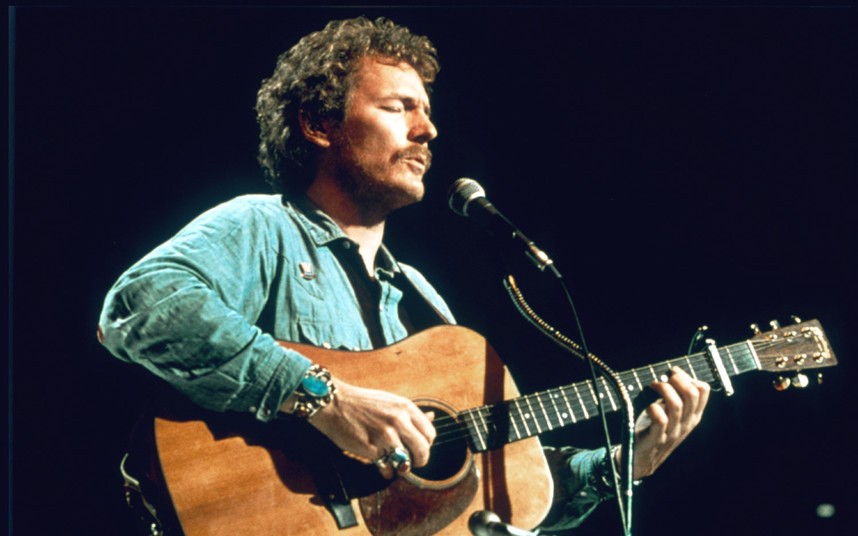
I’m watching an interesting film titled “If You Could Read My Mind.” The Canadian documentary is about the life and career of Gordon Lightfoot.

Lightfoot arrived in downtown Toronto as a young man after growing up in Oridella, a small rural Canadian town. Since there were no clubs to play in at the time, Gordon landed a job in a bank to earn a living. Lightfoot was about to earn a promotion when he told his manager that he had decided to leave the bank to accept a role as an extra on a square dancing Canadian TV show. Lightfoot’s manager found it hard to believe that the young man was leaving a good job with a future to go square dancing.

As folk music became commercially viable in the late sixties, clubs began to spring up featuring promising musicians. Gordon landed a spot in one of them. He stood apart from the crowd because he performed many of his own songs in a characteristically pure voice. After he developed a following, a club owner invited Lightfoot to perform at his club across the street at twice the salary. Lightfoot gratefully accepted the invitation to perform at the Riverboat, Toronto’s premier folk music club.

With his beautiful voice and prolific outpouring of quality music, it was only a matter of time before Warner/Reprise records rewarded Lightfoot with a one million dollar recording contract, an unheard-of number for a Canadian singer. His first album with the new label was released in 1970 when Gordon was forty-two. Lightfoot had left United Artists after five albums because he felt they did not represent him adequately. “Sit Down Young Stranger” shipped 80,000 copies before sales stopped dead. The album “had no legs” in the industry’s parlance. Warner changed the name of the album and picked a new single to lead it off. “If You Could Read My Mind” became a runaway hit when an announcer on an important local radio station kept playing it. Sales of the album ballooned to 650,000 copies. The rest is history.

Here’s my cover of the song.

Gordon Lightfoot is not a “legend in his own mind” as Dirty Harry said about the perp he was about to blow away. Lightfoot is a genuine “legend in his own time.” He has been performing live well into his seventies and beyond. It is said that time waits for no man. Time may have made an exception in Mr. Lighfoot’s case.


Categories
Arts & Entertainment humor inspiration Interviews Music

The Gift

Jim Brickman at the Los Angeles Gracie Awards in 2013

Jim Brickman collaborated with Tom Douglas to write “The Gift.” Jim wrote the melody and Tom wrote the lyrics. Listening to many of Jim’s love songs, I can’t help but think that the man has a heart the size of Kansas.

I found an entertaining video on YouTube describing the story behind the making of The Gift. In the video, Jim reveals a healthy sense of humor about himself, and Tom tells the story with a healthy dose of humor. Here’s an edited version of the story’s opening. For the full version, click here.

Jim: “The Gift is the first song I wrote with Tom. It just felt right from the beginning. I have a recollection of our first meeting, but it’s not very clear. I’d like Tom to give his version of the story.”

Tom: “Mine’s not gonna be very flattering.”

Jim: “That’s alright. They know me.”

Tom: “So, I get a call from my agent saying I have America’s foremost Romantic songwriter and pianist who wants you to do a song with him. Needless to say, I was more than a little intimidated. I’d just moved to Nashville with my family, and I was nervous about everything. So, I walk in to meet Jim for the first time, and he’s matter-of-fact. ‘Hi. Good to meet you.’ That sort of thing. Then he starts in with, ‘I have this song with a title, The Gift. Here’s the goal: I want it to be spiritual, but not religious, seasonal, but not Christmas, and, I want it to be a love song.’

Tom (continued): “So, I’m thinking to myself, I made a terrible mistake leaving my hometown of Dallas. I was kinda like stunned, and Jim goes, ‘Here’s the melody. I’d like the syllables of the words to match the music.’ “And I’m thinking, really? Anything else? So, he goes ahead and plays the melody and I record it. Then he says, ‘Oh. One last thing: I need it by tomorrow.’

And so on. Let’s get to the music. Here’s my version.

Categories
acoustic guitar Arts & Entertainment Music

The Love of My Life

Love In An Open Field

When Jim Brickman began taking piano lessons at the age of five, his first teacher reported to the boy’s parents that he showed little promise as a future pianist. The student didn’t follow directions. He did things his own way.

I can think of four reasons why Jim’s first teacher thought so little of his potential. Either the boy was unusually rebellious, lacking in talent, or mentally ill. The fourth reason proved to be the right one. Jim was born with extraordinary talent. 

Fast forward a half-century. Jim Brickman is known as one of the world’s foremost Romantic songwriters and solo pianists.

Brickman started his career writing advertising jingles. To call the man persistent is probably an understatement.  

To his credit, Jim has recorded twenty-one number-one albums, thirty-two top radio hits, and he has been nominated for two Grammy Awards. He is also a published author and appears on his own radio show, “The Jim Brickman Hour.” Not bad for a kid with no potential. 

Many of Jim’s songs have been covered by leading pop singers such as Carley Simon, Olivia Newton-John, Johnny Mathis, Kenny Logins, and others.   

“The Love of My Life” is one of Jim’s better-known and typically beautiful songs. I’ve adapted it for the acoustic guitar. Here’s my version. 

By Developing the Habit of Focus and Discipline You Will See Your Dreams Come True.

Categories
Folk Guitar Music

A Tribute to Kate Wolf

Who is Kate Wolf? If you’re like most people, you probably have no idea. I’m a huge folk music fan, and I’d never heard of Kate until last year, but I’m happy to have discovered her. Better late than never.  Her music pierces my heart, and the simple beauty of her voice, melodies, and guitar-playing transport me to transcendent realms.

There’s a story that a fan at a live concert once complimented Kate on her earrings.  Without hesitation, she removed the earrings and handed them to the fan.  I believe the beauty of Kate’s music emanated from the beautiful being that she surely was.

Kate Wolf came to prominence during a ten year period from 1975 to 1985.  Tragically, Leukemia brought Kate’s life and singer/songwriting career to a premature end at the age of forty-four.  Despite her foreshortened life span, Kate managed, in her gentle way, to become a major influence on the folk scene with songs like, “Give Yourself to Love,” “Across the Great Divide,” “Green Eyes,” “September Song,” and many more.  In all, she produced seven albums including a “live” in-concert album recorded at a music festival in Mendocino, California.

The appeal of Wolf’s music is the same today as it was when she released her first album on her Owl Records label more than 30 years ago. Her music is plainspoken with powerful natural imagery woven into poignant portrayals of the longings, joys, and sorrows of the heart that transcend romantic stereotypes.

Singing in a plain, pure voice, Wolf never indulged in vocal ornamentation for the sake of effect, and she avoided saccharine sentimentality with her natural sweetness.

As an acoustic guitar-based folk artist, she distinguished herself from such forebears as Bob Dylan, Joni Mitchell and James Taylor, and from her more self-consciously naturalist and mystical contemporaries in “women’s music.”

Now, when cynicism and irony seem to be second nature to pop music, Wolf’s directness rings truer than ever.

“Kate was unique,” says Berkeley-based guitarist Nina Gerber, who was inspired to become a professional musician after seeing Wolf perform in a pizza parlor in Sevastopol, a small town north of San Francisco.  Gerber became Wolf’s key accompanist from 1978 to 1986. Gerber produced the memorial album, Treasures Left Behind, and she has helped organize and produce all four Kate Wolf Memorial Music Festivals.

“She had her own style,” Gerber says. “There was nobody to compare her to. Nowadays, you listen to somebody and they either sound like Shawn [Colvin] or Nanci [Griffith] or Emmylou [Harris] or whomever.

“Kate really took on the environment she was in, so when she wrote about it, it wasn’t contrived. She didn’t go out of her way to try to be flowery and poetic. She pretty much said things the way they were.”

Yet, while Wolf’s songs seem inimitably personal when she sings them, they lend themselves surprisingly well to interpretation.  As a prime example, Nanci Griffith, an unpretentious young woman who once described her music as “rockabilly” and eventually gained an international audience, lends a soul-searing depth and beauty to her interpretations of wolf’s songs.

When Wolf sang of a woman who “rises like the dolphin,” or an “owl calling softly as the night was falling,” it felt true. She brought the listener into her unpretentious realm while prodding him or her to see the natural world anew — always with love as the bottom line.

Wolf, born Kathryn Louise Allen in San Francisco on January 27, 1942, cultivated her approach after moving to Sonoma County in the early 1970’s. She sang songs like “Across The Great Divide,” “Safe At Anchor,” “The Wind Blows Wild,” “Poet’s Heart” and “Give Yourself To Love” in a pure voice, as unaffected, comforting and honest as you want to hear from your lover in the middle of the night. At the height of her popularity, Kate appeared at The Austin City Limits Music Festival and Garrison Keillor’s A Prairie Home Companion.

“I live for a sense of a feeling of purposefulness in this world, you know, that I could stop my life at any point and feel that my life has been worthwhile; that the people I’ve loved and my children have all reached a point where their lives are now going to come to fruit. And as far as something I live by, it’s to try to be as alive as possible and feel free to make my mistakes and try to be as honest as I can with myself.”

Kate Wolf, 1942 to 1986
