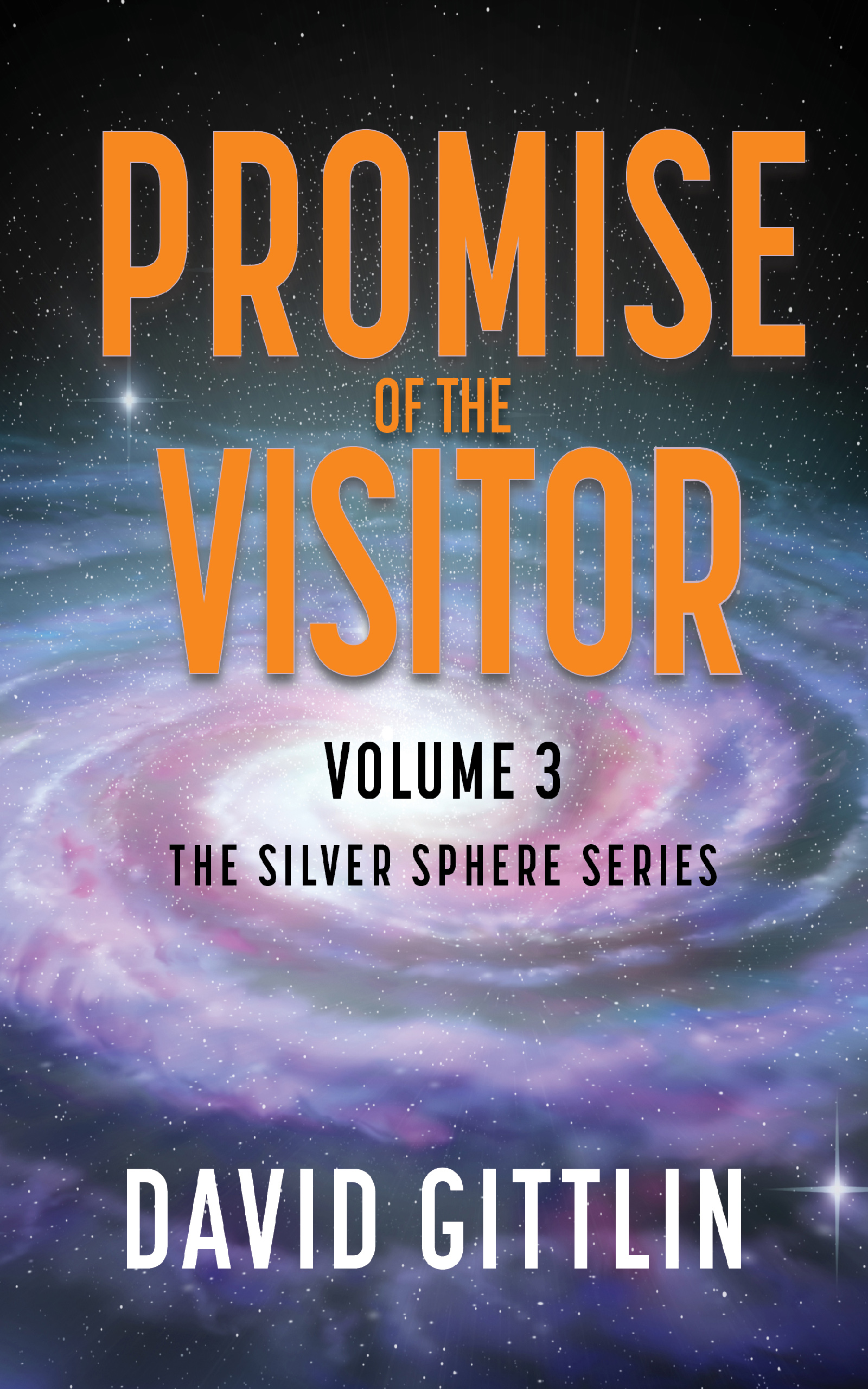
The Explosive Conclusion to the Silver Sphere Series
Volume 3 Coming Early April
On Amazon Worldwide
An unconscious body lies on the kitchen floor. Two Daytona Police deputies are knocking on the front door of the beach house mystery writer Jacob Cassel rents. It’s going to be an interesting morning for Jacob, his super-smart girlfriend, Amy, and Arcon, an AI from the other side of the Milky Way. If they can survive the morning without being thrown in jail, they are expecting a visitor to arrive from the planet Aneleya later in the evening bearing a cornucopia of gifts for the human race. Instead of gifts, the visitor arrives with dire news about a doomsday device threatening the destruction of planet Earth and the entire solar system.
Don McLean released his iconic album, “American Pie,” in 1971. The title song epitomizes the era of the nineteen-sixties. A famous lyric from the title song, “The Day the Music Died,” refers to the day Buddy Holly’s plane went down. Holly and the other passengers, including Ritchie Valens and The Big Bopper, all died in the crash. The song “American Pie” lasts for nearly nine minutes, memorializing other landmark events of the era through rich metaphors. Some of the other outstanding songs on the album include “And I Love You So,” “Crossroads,” “Empty Chairs,” and “Vincent.” I’ve covered these songs in earlier posts on this blog.
“Winterwood” is an upbeat love song featuring McLean’s typically vivid imagery. Technically, the title of the song does not exist in the English language. McLean invented the name to evoke the sights and sounds of a snowy mid-winter day with the sun peaking through barren tree branches and birds chirping in the background. The image came to Mclean as he rode through mid-winter streets recalling fond memories with his wife by his side. The image and the related memories stayed with the artist for six months until he finally wrote “Winterwood.”
The technique is a departure from the finger-picking method I used in many of the other songs I’ve posted. “Winterwood” is played entirely with a guitar pick (flat picking). I abbreviated the introductory lick because it might have taken me six months to learn.
“True Colors” is a song with legs. It started out as a song written for a mother in a traditional ballad format. Billy Steinberg and Tom Kelly wrote the song in 1986 and offered it to Anne Murray, a popular singer at the time. Murray passed on the song. Cyndi Lauper took it and creatively revamped the format into a stark and breathtaking version.
The song became a hit worldwide because of its universal appeal. The songwriters acknowledge that Lauper was the perfect artist to adapt the song partly because of her bold style. Released as the title song on Lauper’s 1986 album, “True Colors,” is the only original song on the album that the artist did not help to write.
In 1998, Phil Collins covered the song on his “Greatest Hits” album. Australian country music star Kasey Chambers covered the song as the theme for the 2003 Rugby World Cup. In 2007, Cindy Lauper launched “The True Colors Tour” to support gay rights and fight hate crimes. In 2016, Justin Timberlake and actress Anna Kendrick used the song in the soundtrack for the movie “Trolls.” Kodak also used the song to advertise its film stock.
Like I said: The song has legs. Here’s my version.
When someone shows you their true colors, don’t try to repaint them.
Time After Time is a Cyndi Lauper song. I’ve never been a big fan of her music, but that doesn’t mean it doesn’t resonate with others. She has a big enough audience without me. This song caught my attention when I heard Eva Cassidy sing it in her beautiful, unique style. It has taken me a few weeks to learn because the fingering is complicated. Eva Cassidy is known for her divine vocals, but trust me, she can play the damn guitar.
The meaning behind a lyric can create a strong connection to a song. It can help you to form a bond with a singer-songwriter. It lets you know the artist has gone through some of the same things you have. Cyndi Lauper’s hit Time After Time is one of those songs for many people. The song was the second single for her debut album, She’s So Unusual. It was actually the last song written for the album, but it made a lasting impact on the album and Lauper’s career.
A TV Guide advertisement for a science fiction movie sparked the idea for the song. Using a simple set of piano chords, Lauper co-wrote the song with Rob Hyman. As the piece evolved, for Lauper it became a response to an ex-lover who was lost and in need of help. She can’t move forward without him by her side.
Over a two-week period, Time After Time was written, recorded, and mastered straight to the album. There wasn’t time for a demo. The song went on to become a number-one hit in the United States. Here’s my version of Time After Time “Eva Style.”
Breaking a big project down into little steps makes it possible to achieve the final result.
Since upgrading my music recording process from the iPhone to a professional microphone and software, I’ve started making music videos illustrated with photos from Shutterstock. This enables me to continue posting songs on my YouTube Channel.
Lately, I’ve been learning songs the way the artist plays them courtesy of my good friend and tutor, JerrysGuitarBar.com. All of these songs are posted on my other blog: davidgittlin.net.
If you are a child of the 1960’s/70’s, then you’ve probably heard of Don McLean’s memorable hit song, “And I Love You So.” What you may not know is that the song was widely covered by other recording artists, most notably Elvis Presley and Perry Como. Yes, I said Perry Como. In a career that spanned decades, Don McLean wrote and recorded twenty-two studio albums, four live albums, and 16 singles. He is best known for his song and album of the same name, “American Pie.” It took the better part of three weeks to master this song, but I enjoyed learning it. The ballad has some beautiful riffs in it. Here is my version of McLean’s hit.
In 1964, Gordon Lightfoot wrote one of his most memorable songs: Early Morning Rain. Lightfoot, a Canadian singer-songwriter, has become a folk legend. Along with his crystal clear singing voice and accomplished guitar playing, Lightfoot has written a library of outstanding folk songs depicting historical events and all manner of love relationships.
To single out a smattering of Lightfoot’s top hits is to do the man an injustice. “Early Morning Rain” appears on his 1966 debut album, Lightfoot! Before he released the song, another Canadian duo, Ian and Sylvia, recorded it in 1964. Many other folk singing notables (Peter, Paul, and Mary) also adopted the song.
The genesis of “Early Morning Rain” can be traced to Gordon’s 1960 stay in Westlake, Los Angeles. At the time, Lightfoot became homesick for his Canadian roots. He remembers going to the Los Angeles International Airport on rainy days to watch the aircraft take-off and land. The memories of the flights launching into the overcast skies stayed with him. In 1964, while caring for his 5-month-old son, Lightfoot remembers thinking, “I’ll put him over here in his crib, and I’ll write myself a tune.” At that moment, “Early Morning Rain” was born.
I’ve always loved this song. Lightfoot strums it. When I heard Eva Cassidy perform the song using a picking technique, I had to learn it her way. Unfortunately, there were no guitar tutorials available. Since Eva plays “Early Morning Rain” close to her version of “Kathy’s Song,” I was able to figure out how to play EMR three-quarters of the way she does. Here’s my version.
Moving Forward
Take the next step that’s in your wheelhouse. This is the path to your success. Don’t overreach. Falling off a cliff is no fun.
“Crossroads” is another great song by Don McLean. It first appeared on his hit album, “American Pie.” Although the song is not as well-known as the title song and some of the other songs on the album (“Vincent”“And I Love You So” and “Empty Chairs“) Crossroads is nonetheless moving and beautiful.
On the surface, the song is about a man remembering a long-lost love with a sense of regret and a desire to turn back time. I believe the subtext of the song has a larger and more universal meaning: hope and happiness can be found with anything that joins us on the inevitable journey of life. It doesn’t have to be a lover or anyone in particular. It can be an idea, a thought, an emotion, or even an absence of something or someone. An absence can be as strong a motivator as a presence.
On the album, McLean performs the song on Piano. Fortunately, my good friend and tutor, Jerry’s Guitar Bar, has transposed the song for guitar. Here’s my version.
BELIEVE IN YOURSELF. BELIEVE IN A POSITIVE OUTCOME. AND, IT WILL BE SO.
Who doesn’t remember Simon and Garfunkle singing Kathy’s song? The answer is probably tons of people under the age of thirty, but who’s counting? The remarkable Paul Simon wrote Kathy’s Song. It was released in 1966 on the album Sounds of Silence. Along with the title tune, Kathy’s Song remains one of the duo’s most popular tracks. It is poetic, lyrical, and deeply moving.
Nearly thirty years later, along comes Eva Cassidy with her celestial voice and consummate guitar playing. Her version of Kathy’s song is characteristically unique and beautiful beyond words. If you like this kind of music, I urge you to listen to Eva’s version on YouTube. Eva doesn’t need an orchestra or a band to back her up. She plays and sings Kathy’s Song solo, and steals your heart away.
I’ve enjoyed learning how to play this song “Eva Style.” I found a good online tutorial by a guy who calls himself Ivor Sorefingers. Here’s my version.
It’s not really been that long. I just said that to get your attention. Have I got it? Good.
Coming Soon!
When Jacob Cassel and his intra-galactic associate, Arcon, discover a dead body on a lonely beach, it is only the beginning of an adventure that holds the fate of our world and other worlds in the balance.
Fifty years have flown by at supersonic speed. I can flash back on memories of my childhood and adolescence and remember them clearly as if they happened yesterday. I try to be present for each remaining moment. I forget. I get lost in my head. Again and again. A week slips by in a day. Does time go slower when we are young? I think it does.
How is time going by for you?
I thought Joni Mitchell wrote and popularized “Who knows Where The Time Goes.” It turns out a British folk rocker named Sandy Denny wrote the song and Judy Collins made it famous. A little research can go a long way. Here’s my version of the song based on the way the late great Eva Cassidy played it.
Science Fiction Writing Tip For Today:
“You have to be out of your mind while knowing what you’re doing most of the time.”
Fifty years have flown by at supersonic speed. I can flash back on memories of my childhood and adolescence and remember them clearly as if they happened yesterday. I try to be present for each remaining moment. I forget. I get lost in my head. Again and again. A week slips by in a day. Does time go slower when we are young? I think it does.
How is time going by for you?
I thought Joni Mitchell wrote and popularized “Who knows Where The Time Goes.” It turns out a British folk rocker named Sandy Denny wrote the song and Judy Collins made it famous. A little research can go a long way. Here’s my version of the song based on the way the late great Eva Cassidy played it.
Science Fiction Writing Tip For Today:
“You have to be out of your mind while knowing what you’re doing most of the time.”